Wrestling with Truth November 27, 2011

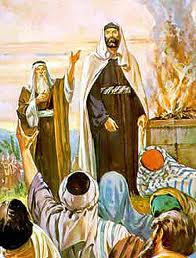
ELIJAH AT MOUNT CARMEL (1 Kings 18)

Brief review of the opening chapters of I Kings

  • Adonijah sets himself up as king
  • David makes Solomon king
  • Solomon asks for wisdom
  • Solomon builds the temple
  • The ark brought to the temple
  • Solomon’s prayer of dedication
  • The queen of Sheba visits Solomon
  • Solomon’s wives
  • Solomon’s death
  • Israel rebels
  • Golden calves at Bethel and Dan
  • One bad king follows another
  • Elijah fed by ravens
  • The widow at Zarephath

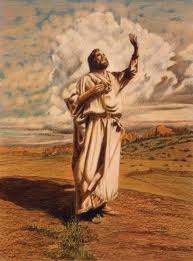
Elijah at Mount Carmel:  Pivotal story in all of scripture—the LORD Yahweh against Baal and his false prophets

1.   recognize the CHOICE between two opinions; Yahweh versus Baal

2.   accept the CHALLENGE of Elijah; pray down fire from heaven on the altar

3.   return to point of CONTACT with Yahweh at Mount Carmel; Elijah repairs altar

4.   radical CLEANSING; fire burns up sacrifice and altar; prophets of Baal are slain and the mountain is cleansed; see Deuteronomy 12 for a “policy” statement on cleansing

5.   look for the CLOUDS of rain to break the drought in God’s timing; small first; bigger later

Charles Wesley’s pertinent hymn:

O Thou who camest from above,
The pure celestial fire to impart,
Kindle a flame of sacred love
Upon the mean altar of my heart.

There let it for Thy glory burn
With inextinguishable blaze,
And trembling to its source return,
In humble prayer and fervent praise.

Jesus, confirm my heart’s desire
To work and speak and think for Thee;
Still let me guard the holy fire,
And still stir up Thy gift in me.

Ready for all Thy perfect will,
My acts of faith and love repeat,
Till death Thy endless mercies seal,
And make my sacrifice complete.

William Temple’s definition of worship:

  • To quicken the conscience by the holiness of God,
    to feed the mind with the truth of God,
    to purge the imagination by the beauty of God,
    to open up the heart to the love of God,
    to devote the will to the purpose of God.”

Colin Smith summarizes:

  1. Authentic worship is a response to revealed truth–(1 Ki 18:21 NIV)  Elijah went before the people and said, “How long will you waver between two opinions? If the LORD is God, follow him; but if Baal is God, follow him.” But the people said nothing.
  2. Authentic worship focuses on the living God–(1 Ki 18:37 NIV)  Answer me, O LORD, answer me, so these people will know that you, O LORD, are God, and that you are turning their hearts back again.”
  3. Authentic worship focuses on an acceptable sacrifice–(1 Ki 18:38 NIV)  Then the fire of the LORD fell and burned up the sacrifice, the wood, the stones and the soil, and also licked up the water in the trench.

TLT

Posted in Wrestling with Truth | Tagged , , | Leave a comment

Wrestling with Truth November 20, 2011

Using 1 Samuel 13 and 15, and 2 Samuel 11 and 12 as background, we addressed the tragic stories of Saul and David as they proclaimed “I have sinned” in response to the words of the prophets Samuel and  Nathan, respectively.

We outlined the sins of these two men.  Saul: arrogance, disobedience, jealousy, impatience, witchcraft.  David: adultery, murder, deceit.  We compared the severity of these sins.  Did one man sin more than the other?  Why was David forgiven and Saul not?

The sentiment was that sin is sin but there was the recognition that some sins have greater interpersonal implications than others.

Then, the main thrust turned to the steps (the order is not final) in redemption from sin toward salvation:

  • IDENTIFICATION (AWARENESS)
  • CONVICTION
  • CONFESSION
  • REPENTANCE (change of direction, contrition, commitment to amendment)
  • FORGIVENESS
  • CLEANSING
  • RESTITUTION
  • ASSURANCE
  • CONSEQUENCES

We were moved by the prayers of repentant prayer by David given to us in Psalm 32 and Psalm 51 which were read out loud for us.

David was forgiven and restored because of his heart-attitude of humbleness and his commitment to changed behavior.   Saul was not forgiven due to his continuing heart-attitude of rebellion which was reflected in his failure to change and his persistence in making excuses for his behavior.  David acted responsibly; Saul did not.

TLT

Posted in Wrestling with Truth | Tagged | 1 Comment

A Christmas Guest

I read yesterday Ann Perry’s A Christmas Guest.  (Context: Flying home from New York to Kentucky.  Yeah! . . . Oops!  Yes, Dad, I still love you!)

Meet Mariah Ellison, one grumpy, snobby, English grandmamma who no one really likes but who is nevertheless lovingly cared for. An unexpected turn of events transforms self-focused Grandmama into a detective looking to find the murderer—?—of her new-found friend.  In the process, a wonderful thing happens.  Grandmama finds a new lease on life.  Almost by accident she discovers that this moment is the perfect time to start life over: to re-create who she is; to choose to find joy and wonder and excitement in the simple pleasures of living. (Of course, she solves the murder mystery, too, but that’s another story!)

I’m intrigued. If I were to sit down and intentionally create a “new self,” who would I be? What do I want to value most? How do I translate these values into everyday living?

jlt

Posted in Ideas to think about | Tagged , , | 1 Comment

Barometer Rising

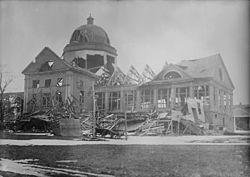
Building damaged by explosion

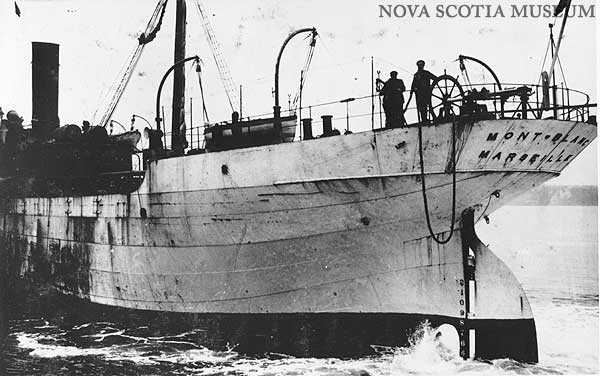
I have just completed reading Hugh MacLennan’s Barometer Rising (1941).   If you are looking for a Canadian love story set in the context of World War I and the catastrophic explosion of the Mont-Blanc (a freighter carrying explosives) in the Halifax harbor on December 6, 1917, this is it.  Great reading.

Barometer Rising describes a World War I soldier who has been injured and “demobilized”.  He is blamed for tragic events in the war that were not his responsibility.  Returning to Halifax, he struggles to clear his name and he also strives to re-kindle the loves of yesteryear.  The explosion gives him a whole different focus and he is able to be concerned about others instead of only himself.  His “shell-shock” seems to fade away as he leads in the recovery from the Mont-Blanc explosion and in the process he learns who he really is and who he really loves.  In many ways he represents the many men who moved from the fisheries and mining of Cape Breton into the city life of Halifax.

What this book tells me is that in times of great crisis there is opportunity to reevaluate commitments and priorities.  Out of crises come opportunities to change oneself and to change one’s world.

Note:  “The Halifax Explosion remains the world’s largest man-made accidental explosion.”

Read more at http://en.wikipedia.org/wiki/Hugh_MacLennan and http://en.wikipedia.org/wiki/Halifax_Explosion.

TLT

Posted in Ideas to think about | Tagged , | 1 Comment

A prayer for today

Denis Duncan offers this simple but profound prayer:

Give me, O Lord
unlimited patience
unlimited understanding
unlimited love
Then I will be able to forgive
as I have been forgiven
to bless
as I have been blessed.  Amen.

Posted in Ideas to think about | Tagged | 2 Comments

Wrestling with Truth November 13, 2011

The Prophets

Three great stages of OT History:

Patriarchs  —  tribal rulers, carried out sacrifices, represented families before God; covenant; transmitted the blessing; hereditary; tendency toward corruption

Priests  —  after Sinai the priestly function passed to the tribe of Levi; hereditary, tendency toward corruption; retained their institutional and conservative function on into NT times; real moral and spiritual leadership of the nation passed to the prophets

(cf. Exodus 19:6 and 1 Peter 2:9 – nation of priests)

Prophets  —  parallel the apostles in the NT;  responsible for the writing and perseveration of many of the books of the OT;  Abraham (patriarch), Moses (law-giver), and Samuel (the last of the judges) seem to cross over all three functions

[which one of these typifies you in your work or within your family?]

In Hebrew Bible, Joshua, Judges, I & 2 Samuel, and 1 & 2 Kings are named “the Former Prophets”; latter prophets: Isaiah, Jeremiah, Ezekiel, and the 12 minor prophets

Scope of prophet’s work:

  • Illumination of the past, especially as historical writing
  • Judgment of the present, especially as admonition and call to repentance
  • Foretelling of the future, especially as warning and comfort, namely:
    • Judgment upon Israel
    • Judgment upon the nations of the world
    • The conversion of Israel
    • The conversion of the nations of the world
    • The Messiah and His Kingdom

1.         roeh or chozeh (derived from terms that mean see, behold, gaze upon, view, see, complete)

Earlier term;  (1 Sam 9:9 NIV)  (Formerly in Israel, if a man went to inquire of God, he would say, “Come, let us go to the seer,” because the prophet of today used to be called a seer.)

One who “saw”; his message was often called his “vision”

2.         nabi  (one who speaks, one who announces, one who speaks for another, spokesman); Moses and Aaron

Far more common term

True prophet spoke what God gave him to speak
False prophet spoke from his own imagination

  • (Deu 18:20-22 NIV)  But a prophet who presumes to speak in my name anything I have not commanded him to say, or a prophet who speaks in the name of other gods, must be put to death.” {21} You may say to yourselves, “How can we know when a message has not been spoken by the LORD?” {22} If what a prophet proclaims in the name of the LORD does not take place or come true, that is a message the LORD has not spoken. That prophet has spoken presumptuously. Do not be afraid of him.

“Speaking the word of the Lord frequently involved prediction, foretelling the future.  More often it meant proclamation, “forth-telling” a message from God.”

Jeremiah mediates the word of God:  (Jer 1:9 NIV)  Then the LORD reached out his hand and touched my mouth and said to me, “Now, I have put my words in your mouth.

“The prophet received the word by divine inspiration but communicated it through his own personality.  The communication therefore bears the mark of the prophet’s personality as well as the credentials of divine authorship.”

“The prophet, unlike the priest, was not born to his office.  He was called to it and especially endued with the Spirit of the Lord to accomplish its purposes.  His experience of the divine was never for the sake of his own mystical enjoyment.”

“The mission of the prophets was to bring an understanding of the will of God as it applies to all of life.  The prophets were undying foes of cloistered piety, religion confined to the Temple ritual.  Politics, commerce, justice, and the daily dealings of man with man were all brought under the judgment of God.”

[From W. Purkiser, R. Taylor, and W. Taylor, God, Man, and Salvation, pp. 145ff.]

Preacher??  Is this the fourth category after patriarch, priest, and prophet?

External and internal perspectives

Peter Taylor Forsyth:  “You cannot quench the preacher without kindling the priest.”

TLT:   Among other ways, revelation expresses itself through mind and heart.  If mind is thwarted, the heart will find a channel.  If the heart, is restricted the mind will address the issues.  God is at work through priest and preacher.  Sometimes God’s truth is seen and felt in the beauty of liturgy and orderly structure and sometimes in the clear proclamation of rational truth.  God is at work in the whole person.

TLT

Posted in Wrestling with Truth | Tagged , , | Leave a comment

Wrestling with Truth November 6, 2011

KINGS, THRONES, AND HOUSES

2 SAMUEL 7

Today we addressed the account in 2 Samuel 7 of David’s proposal to build a ”house” for God — a temple.  David is informed through Nathan that this will not be his role.  His son, Solomon, will be the one to build the temple.  Instead God promises David a house which is in fact the family line which bears the Saviour, Jesus.

David prays a great prayer of submission which includes:

“What more can David say to you? For you know your servant, O Sovereign LORD” (2 Sam 7:20 NIV).

  • In these words David submitted himself finally to God.  His desire to build the house of God was perfectly natural.  So much was this the case that it appealed to Nathan, who advised him to do all that was in his heart.  It was not, however, in the will of God that he should carry out this work; and consequently the prophet was sent to deliver a message which was neither in agreement with David’s desire, nor with his own opinion.  The story reveals the triumph both of Nathan and David in their ready submission to the declared will of God.   The prophet unhesitantly delivered his message, even though it contradicted his own expressed view.  It takes much courage on the part of a prophet to do this kind of thing.  David immediately acquiesced in the will of God, and worshipped.  The desire in itself was not necessarily wrong.  Solomon, when referring to this matter at the Dedication of the Temple, said:  “Jehovah said unto David my father, Whereas  it was in thine heart to build an house for My name, thou didst well that it was in thine heart” (I Kings 8:18).   Yet it was not God’s will that he should do it, and his submission to that will was the essence of wisdom.   It is of the utmost importance that we should ever test our desires, even the highest and holiest of them, by His will.  Work, excellent in itself, should never be undertaken, save at the express command of God.  The passing of time will always vindicate the wisdom of the Divine will.  (G. Campbell Morgan, Searchlights from the Word, p. 99)

In time, as we “travel” through the prophets and the New Testament, we come to understand that God does not live in a house made by human hands.  His house is his people as the following verses explain:

(Heb 3:6 NIV)  But Christ is faithful as a son over God’s house. And we are his house, if we hold on to our courage and the hope of which we boast.

(1 Pet 2:4-5 NIV)  As you come to him, the living Stone–rejected by men but chosen by God and precious to him– {5} you also, like living stones, are being built into a spiritual house to be a holy priesthood, offering spiritual sacrifices acceptable to God through Jesus Christ.

(Acts 17:24 NIV)  “The God who made the world and everything in it is the Lord of heaven and earth and does not live in temples built by hands.

(Eph 2:19-22 NIV)  Consequently, you are no longer foreigners and aliens, but fellow citizens with God’s people and members of God’s household, {20} built on the foundation of the apostles and prophets, with Christ Jesus himself as the chief cornerstone. {21} In him the whole building is joined together and rises to become a holy temple in the Lord. {22} And in him you too are being built together to become a dwelling in which God lives by his Spirit.

TLT

Posted in Wrestling with Truth | Tagged | Leave a comment

Gray Valley and the Mud

This past Thursday I ventured out with my father-in-law to investigate the environs of Gray Valley, the small farming territory of northern Pennsylvania where he was born and raised.  We had made this trip before but not  recently.

It rained most of the time but we were able to see and photograph several old houses and barns that he knew from his childhood and young adulthood and some beautiful landscapes.  We enjoyed a hearty lunch at the Iron Skillet restaurant in Sylvania.

The most exciting part of the meandering trip was our encounter with “mud” on the Gray Valley Cemetery Road.  The rain and current grading had turned the road into a quagmire.  We were too far down the road before we realized the depth of the mud and its viscosity.  We encountered a large truck and a grader which both “graciously” allowed us to pass but since they occupied more than half the road it was tricky.  For several moments I envisioned wading through mud, and tow trucks, and just plain aaaarrrggghhh!  Whatever that is!  With mud flying and the traction control grinding, I managed to pass both vehicles in turn and get back to solid ground.

The whole experience reminded me of Christian’s “slough of despond” adventure in John Bunyan’s Pilgrim’s Progress and I was much encouraged not to be traveling on foot with the pilgrim–at least not on that part of the road to the Celestial City.

The trees were indeed beautiful.  It was great fun for a rainy day in October.

TLT

Posted in Adventures | Tagged , | 1 Comment

Sunday in October

This past Sunday I attended a large church in the Binghamton, New York, area with some members of the family.  It is a well-appointed modern building with all the bells and whistles.  I had been there twice before so I knew what to expect.  Actually it was a pretty good experience. This was my first time to hear the pastor preach.

The service had three parts:  announcements and offering, sermon, three songs.   This sequence was apparently a change from usual practice in that the pastor wanted the sermon first so that the proclamation of the Word could then be celebrated with the subsequent songs.  I thought this worked well since the style of music was not exactly “my cup of tea.”  And with the sermon first–using up time–the songs seemed briefer than I expected.

The sermon, based on James 1, addressed the problem of temptation and emphasized that temptation does not come from God.  The sermon was biblical and well presented; interesting and thoughtful.  It was certainly something that we all need to hear.  I would have liked a little more Romans 8 to resolve the Romans 7 references.  I am leaving this a little cryptic for those who want to reflect more.

I was a little disappointed with the comments at the end of the sermon about what happens to people who fall into sin (as the result of temptation) and then continue in that state over time.  It seems logical to me that a Christian who falls into sin and continues in that pattern over time is hardly a Christian any more.  The pastor seemed to be saying that God would “take them by death” before they went too far.  I have always felt that, on this topic, people need to read Ezekiel 18 a little more often.  (You may wish to have  a look and see what it says.)

God wants people to be transformed through the saving work of Jesus Christ and then to live in a growing relationship with him.  God wants people to be changed and not continue on in their old patterns of living in sin.  Is there forgiveness for a Christian who falls into sin? Definitely, yes!  Does God hang on to his people?  Sure.  Does there come a time when a Christian who has turned his back on God is too far gone for God’s love?  No.  But God will not violate that person’s free choice to be his own person even if that means losing him.

Well, I doubt that I can settle this issue.  I will leave that to Mr. Calvin and Mr. Wesley and others.  Good people can differ on many of these points.  Let’s not throw the baby out with the bathwater.

Overall,  it was a good and helpful sermon.

Well, this is getting a little deep for 7 a.m. on a Wednesday.

TLT

Posted in Ideas to think about | 1 Comment

Wrestling with Truth October 16, 2011

Samuel presents Saul

KING                  I Samuel 8 and Deuteronomy 17:14-20

(outline from Raymond Brown and some ideas from Colin Smith)

As Samuel, the prophet, reaches his final years, the people of Israelite renewed their call for a king.  They wanted to be like other nations.  We find this account in I Samuel 8.  Samuel felt rejected but God reminded Samuel that it is God that is being rejected (1 Sam 8:7).  God agreed to give the Israelites their desire and Saul was anointed as king (I Sam 10:1).

Samuel reminded the people of all of the bad things kings do (see I Sam 8:10-18).

Interesting Deuteronomy 16-18 had already defined the criteria for various categories of leader: judge, king, priest, and prophet.   Deuteronomy even anticipated that the people will want a king (17:14).

  • The king must be anointed by God.  The king must not be pretentious. —  “be sure to appoint over you the king the LORD your God chooses” (15).
  • The king must belong to God’s people. – “He must be from among your own brothers. Do not place a foreigner over you, one who is not a brother Israelite” (15).
  • The king must not be afraid. — “The king, moreover, must not acquire great numbers of horses for himself or make the people return to Egypt to get more of them” (16).
  • The king must not be disloyal. – “He must not take many wives, or his heart will be led astray” (17).
  • The king must not be materialistic. – “He must not accumulate large amounts of silver and gold” (17).
  • The king must not be ignorant — “When he takes the throne of his kingdom, he is to write for himself on a scroll a copy of this law, taken from that of the priests, who are Levites.  It is to be with him, and he is to read it all the days of his life . . .” (18-19).
  • The king must not be disobedient. — ” . . . so that he may learn to revere the LORD his God and follow carefully all the words of this law and these decrees and not . . . turn from the law to the right or to the left (19-20).
  • The king must not be proud. – “ . . . and not consider himself better than his brothers” (20).

New Testament leadership parallels:

  • (Mark 10:45 NIV)  For even the Son of Man did not come to be served, but to serve, and to give his life as a ransom for many.”
  • (Phil 2:7 NIV)  but [Jesus] made himself nothing, taking the very nature of a servant, being made in human likeness.

What does contemporary leadership look like?

What kind of leaders do we need?

We need leaders that God chooses; that are committed to His truth and His word; that value God’s will over alliances of religion, military might, money, or family;  that are obedient to God’s direction; and that are not proud but willing to humble themselves before others and God’s truth.

TLT

Posted in Wrestling with Truth | Tagged | 2 Comments